
Does the participant feel located inside the environment?
Scale, viewpoint, motion tracking, and stable spatial relationships support the sensation of being there.
Investigating the point at which a rendered environment stops feeling like an image and starts being treated as a place.
The central research question
Research scope
Presence is not a synonym for visual realism. Research distinguishes the sensation of being located inside a virtual place from the plausibility that events inside it are genuinely happening. A visually detailed room can still feel artificial when sound, scale, body movement, object behaviour, or social response contradict one another.
Inviox will examine presence as an observable response rather than a marketing adjective. The study will combine established questionnaires with navigation, memory, hesitation, avoidance, and reaction to controlled events. It will also record discomfort so that a stronger illusion is never treated as automatically better.
Why this question
The experiment separates four factors that are usually changed at the same time.
Scale, viewpoint, motion tracking, and stable spatial relationships support the sensation of being there.
Objects, characters, and the environment must respond coherently to movement, attention, and action.
Tracked hands, reach, posture, latency, and collision can be more important than visual detail alone.
Initial Inviox study
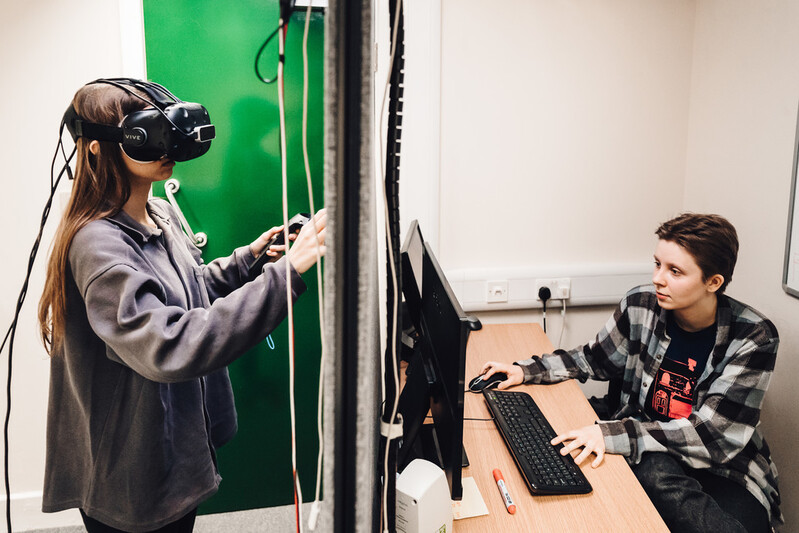
Participants will experience matched versions of the same short virtual room. Visual fidelity, spatial audio, bodily representation, and environmental response will be isolated and recombined to identify which changes affect subjective presence and observable behaviour.
Separate place illusion, plausibility, embodiment, attention, comfort, and enjoyment instead of combining them into one score.
Create versions of the same eight-minute environment in which only the tested sensory or behavioural factor changes.
Test event timing, tracking stability, readability, accessibility, and simulator discomfort before recruiting the main sample.
Set hypotheses and exclusions in advance; randomize condition order to reduce learning, fatigue, and novelty effects.
Combine validated questionnaires with task accuracy, spatial memory, movement, hesitation, avoidance, and response to a controlled event.
Identify which combinations produce meaningful change, which add cost without benefit, and which increase discomfort.
What will be measured
Participant protections
Research value
This page does not claim a result. It defines the evidence and public outputs the study is expected to produce.
A comparison showing which sensory and behavioural combinations meaningfully change the experience.
A controlled real-time environment that can be repeated by other educators or researchers.
Evidence-based recommendations for allocating effort between graphics, audio, embodiment, and interaction.
A parallel report documenting when stronger sensory intensity increases discomfort or excludes participants.
Evidence base
Presence research gives Inviox established concepts and measurement approaches; the selected combination and production context remain the subject of our study.
INVIOX / RESEARCH
Researchers, designers, audio specialists, and accessibility practitioners can contribute to the study design and review criteria.